
Today, the 1st of January 2026, it is exactly 50 years ago when my initial VHF licence became valid. The picture below shows a copy the initial licence (which I no longer have). We had to return documents to the administration when a licence was changed, which happened in 1977 after the CW test was passed.
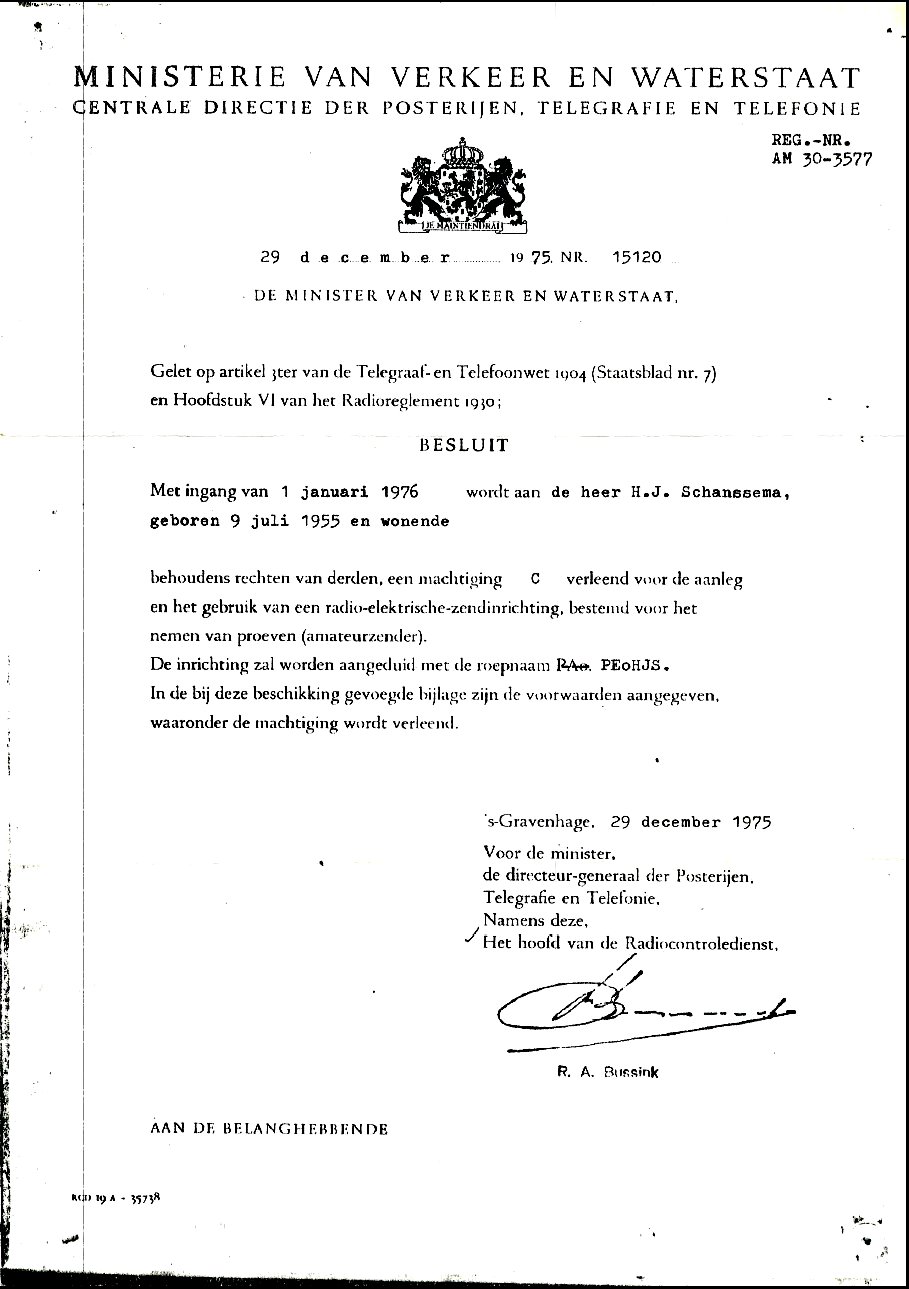
Details were typed on a printed sheet. Before 1976, only PA0 prefixes were issued (except a few special licences). The PA0 prefix was printed and only the suffix had to be typed. The PEo prefix was introduced in 1976. But no problem, the PA0 prefix was crossed out and the entire call sign was typed.
First endeavours as PE0HJS
Knowing that I passed the exam and only had to wait for the paperwork, I contacted the local radio club and it did not take long before I got a 144 MHz transmitter and antenna. It came from a silent key. I already had a home made receiver and it was quite reasonable.
The transmitter was a modified mobile radio transmitter with a 24 MHz VFO, driving multiplier stages. The output was about 15 Watts from a QQE 03/12, a double tetrode. The picture below is from an application note of Philips.
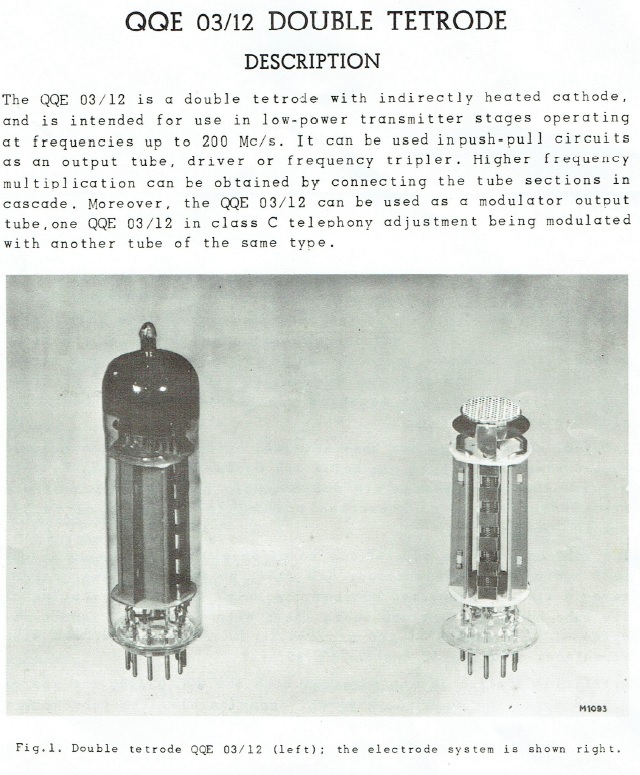
The transmitter dated from the crystal controlled AM era, but the VFO could be FM modulated. Many contacts were made and the transmitter never failed me.
Going up instead of down
I always wanted to become active on the HF bands and practised CW to get the full licence. But in the meantime, I was encouraged to explore UHF and up and even though I passed the CW test and got the full licence in 1977, the high frequencies became centre stage. Credits to Dolf PA2DOL (who lived near me when I was younger). Dolf helped me a lot with partly or even wholly built equipment for UHF/SHF. Only one station in my area was active on 23 cm. Higher bands were mostly eternal noise. Without proper measurement equipment which I did not have, transmitting was essentially a shot in the dark. So I travelled quite a lot to get assistance and make sure things were working on the frequencies where they were supposed to be.
Later on, I became aware that exploring unknown territory was my avenue. So much to discover and it gives much satisfaction when something works. I remember having built a multiplier from 1152 to 3456 MHz which produced maybe just 10 mW. On a day with good tropospheric conditions I asked Jan, PA0JGF to give it a try. I must have jumped one metre high when Jan reported receiving me. Imagine, just a small helical antenna at my end. Jan had a good station with a 2 m dish but spanning about 150 km with so little radiated power, amazing.
Until September 1994 I was active on microwave. Seldom missed a contest and often attended microwave meetings. Real friends, helping and inspiring each other.
From crossband to 6 m DXCC
Different, but also unknown territory was 50 MHz. I read that contacts across the pond might be possible during the upcoming solar cycle. Cycle 21 was to be an amazing cycle (which I did not know at the time). The first amateur signal heard was the ZS6PW beacon in March 1979. I was speechless.
I always had a portable Uher recorder ready and got things taped:
Quite a few stations from te USA, Canada and the Caribbean were heard or worked crossband. Also heard YV and the FY7THF beacon was a “regular”. C51AEH from The Gambia had a great signal. .
I remember receiving television on (CCIR) channel 2 from the Middle East, but the ionosphere acted as a low pass filter, causing the picture to be distorted.
In 1987, the news broke that 50 MHz would be granted to us in March 1988. A few weeks later, a transverter was ready and a 5 elements Tonna was on the roof. Listening tests revealed that television carriers near 49.750 MHz from the east (OIRT system) were a steady stream of meteor bursts and pings.
A notice of variation was needed, but a request was promptly responded by our administration. We were (and are) lucky to have an “amateur friendly” administration.
Many contacts followed and an increasing number of entities issued permissions, allowing new entities to be logged. But it took over 4 years to pass the 100 mark. Blood, sweat and tears, but it was a great time, never to return.
Fast forward 2026
One might say that many radio “amateurs” nowadays are mainly radio operators. There are even those who claim that technical exams are a thing from the past, because it does not require technical knowledge to operate commercial equipment. One of the most frequently asked questions on a Dutch forum is “Which transceiver or antenna should I buy?”.
The future
When I look into a crystal ball, I seriously doubt if the community as it once was, will ever return. Will the ham radio license focus solely on operating and safety? Technical knowledge no longer required? The equipment display tells you what to do in case of trouble and it is easy to imagine (internet connected) transceivers sending data to the manufacturer to get instructions how to address a problem of even provide “assistance” in case of malfunction. Like modern day appliances which are connected to the internet.
Imagine the future, where within seconds even before you notice that your transceiver is malfunctioning, you will receive a message and can chat with an AI assistant.
Will we be forced to buy equipment licenses, requiring fees to keep equipment “activated”?
If we look at appliances, we see a vendors charging yearly “license” fees in the tune of 20-25% of the sales price (which is usually already steep). Without a license, nothing works. “Not activated”. A bad dream? Or?
Back to operators versus amateurs
It is often forgotten that we have access to a lot of spectrum because is was justified by the fact that radio amateurs contributed to technological development. For many, like myself, ham radio provided solid knowledge and hands on experience which I later applied professionally.
Operators with commercial equipment will no longer provide justification for spectrum allocations and on the long run, spectrum will be lost. The best case scenario is that some breadcrumbs remain, like spectrum with little practical use for commercial applications.
Curiosity can save us … but always with care 
As long as I can remember, I always have been curious and wanted to know how things work. I must have had a guardian angel because some of my early experiments could have been fatal. Like trying a Lego light brick with 220V around 1960 when I was 4 of 5 years old. There was a paper in the box with instructions how to connect things to a 4.5 V battery.
Lacking a battery, I reasoned that because lights in our home were connected to the mains outlets, I could try to connect my newly acquired light brick to the outlet. It worked, but only once with a bright flash and a bang. I was very disappointed. I told my mother what happened. Her face was rather pale.
Imagine, no differential breakers at the time.
When I was on my way home from school, I usually took different routes (I knew all roads as a result) and there was always something to be discovered. Unlike today, safety was essentially a matter of common sense and the modern day paranoia safety guidelines did not exist. It was usually permitted to enter a yard and have a peek. I remember getting a door bell transformer from a worker, him telling me how to connect it (he made me aware of primary and secondary windings of a transformer…). I must have been 8 or so. Lots of things were tried with lights and stuff, using the transformer.
One accumulated lots of experience with technical things and also gained knowledge about underlying principles. The success factor was a very important driving force. Most learning experiences were very satisfying and helped to accept unexpected outcomes.
The bricked brick (h.i.) was an important lesson which will not be forgotten. The same goes for many experiments, either good or bad.
Basic Lego bricks are tremendous toys because they offer a lot of learning opportunities. It stimulates imagination and gives satisfaction. Modern day Lego kits are essentially one off projects. Because most of the elements cannot be “repurposed”, resulting in a completed project gathering dust.
In my opinion, we have to focus on ways to stimulate curiosity and experimenting. In a next post, I will try to dig deeper and hope to formulate some ideas.